
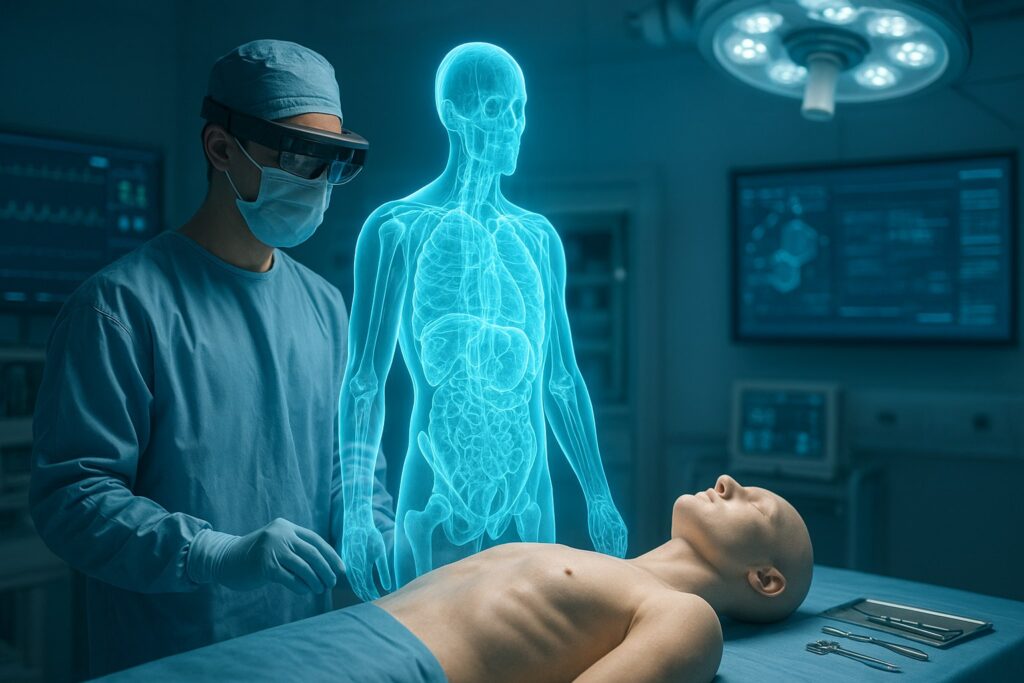
Step into a modern teaching hospital today and you might witness something that would have seemed like science fiction a decade ago: a surgeon rehearsing a complex spinal procedure on a holographic patient before making a single incision, or a medical student in Aberdeen collaborating with peers in Auckland, examining the same three-dimensional heart floating between them. Augmented reality (AR) is no longer a novelty confined to gaming and smartphone filters—it is fundamentally reshaping how medical professionals learn, practise, and perfect their craft.
The statistics speak volumes about this transformation. The global AR healthcare market was valued at approximately £1.2 billion in 2023 and is projected to grow at a compound annual growth rate of around 25% through the decade. More telling still, a 2022 study published in JAMA Surgery found that surgical residents trained with AR-enhanced simulators completed procedures 20% faster and with 38% fewer errors than those trained using traditional methods alone. These figures signal a paradigm shift in medical education—one where the boundary between digital instruction and hands-on experience becomes increasingly blurred.
From Textbooks to Holograms: The Evolution of Medical Training
For centuries, medical education followed a predictable pattern: dense textbooks, two-dimensional anatomical charts, and observation-based learning under the watchful eye of senior clinicians. Whilst cadaver dissection remains invaluable, it offers a static, one-time view of human anatomy. The Royal College of Surgeons estimates that traditional surgical training requires approximately 5,000 hours to achieve basic competence—a substantial investment that AR technology is helping to streamline.
Augmented reality bridges the gap between theoretical knowledge and practical application. Unlike virtual reality, which creates entirely digital environments, AR overlays computer-generated imagery onto the real world. In the operating theatre context, this means a trainee can see a patient’s actual body whilst simultaneously viewing digital reconstructions of underlying structures—veins, tumours, or bone fractures—projected precisely where they lie beneath the skin.
Breaking Down the Technology
Modern medical AR systems typically employ three core components:
- Head-mounted displays (HMDs): Devices such as Microsoft HoloLens 2 or Magic Leap 2 project digital content directly into the user’s field of vision, leaving hands free for instruments.
- Spatial mapping: Advanced sensors create real-time three-dimensional maps of the physical environment, ensuring digital overlays remain precisely anchored to anatomical landmarks.
- Haptic feedback: Specialised controllers simulate the tactile sensation of cutting tissue or suturing, adding a crucial sensory dimension to training scenarios.
The result is an immersive learning experience that engages multiple senses simultaneously—a critical factor in muscle memory development and procedural confidence.
Practical Applications Transforming the Operating Theatre
The integration of AR into surgical training extends far beyond anatomical visualisation. Healthcare institutions worldwide are deploying this technology across multiple specialities with remarkable results.
Preoperative Planning and Rehearsal
Surgeons at Imperial College London have pioneered the use of AR for preoperative planning in complex oncological cases. By converting CT and MRI scans into interactive three-dimensional models, surgical teams can “walk through” procedures beforehand, identifying potential complications and optimising their approach. One notable case involved the removal of a tumour near a patient’s spinal cord, where AR rehearsal reduced operating time by 90 minutes—a significant benefit given that each hour under general anaesthesia carries additional risk.
Real-Time Intraoperative Guidance
During actual procedures, AR headsets can display vital signs, imaging data, and step-by-step procedural guidance without requiring surgeons to look away from the operative field. In orthopaedic surgery, systems such as Augmedics’ xvision have demonstrated accuracy rates exceeding 98% for pedicle screw placement—a procedure where millimetre-level precision is essential to avoid nerve damage.
Dr Sarah Chen, a consultant neurosurgeon at a major London teaching hospital (speaking in a personal capacity), notes: “The ability to see a patient’s vasculature overlaid directly onto the brain during aneurysm surgery has transformed our approach. It’s like having X-ray vision, but with context and depth that traditional imaging simply cannot provide.”
Remote Collaboration and Telementoring
Perhaps most transformatively, AR enables experienced surgeons to guide colleagues from anywhere in the world. During the COVID-19 pandemic, platforms such as Proximie facilitated over 20,000 remote surgical collaborations, allowing specialists to annotate the operative field in real time for trainees in different hospitals—or different continents. This capability proved particularly valuable for rural and underserved regions where access to specialist mentorship has historically been limited.

Beyond the Theatre: AR Across Medical Education
Whilst surgical applications capture headlines, AR’s influence permeates every stage of medical training.
Anatomy Education Reinvented
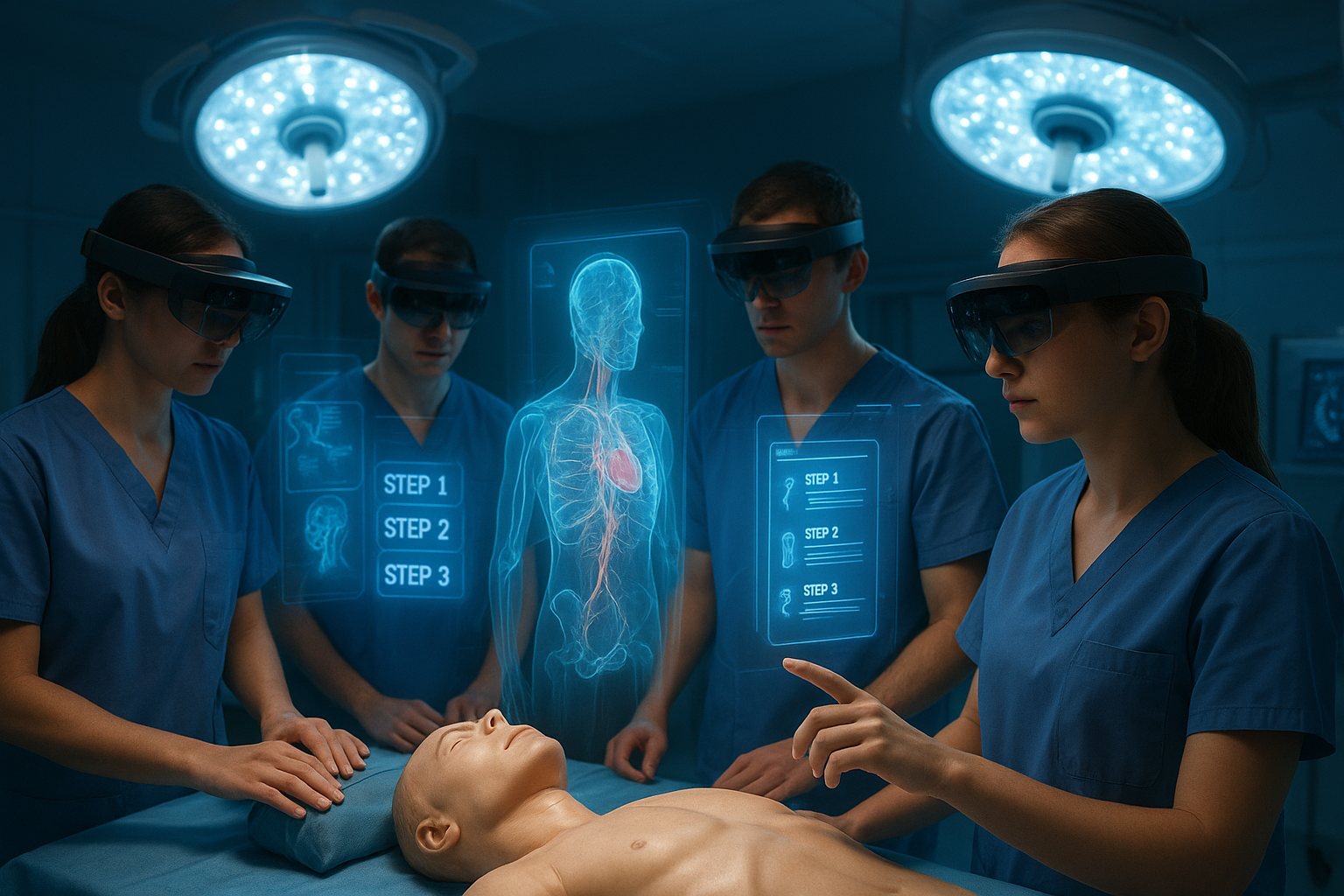
Medical schools including Case Western Reserve University and the University of Edinburgh have integrated AR anatomy platforms into their curricula. Students can explore holographic organs, isolating systems—nervous, circulatory, musculoskeletal—and observing pathological changes in ways impossible with traditional specimens. Early evidence suggests this approach improves spatial understanding and long-term retention, with one 2023 study reporting test scores 14% higher among AR-trained cohorts.
Simulated Patient Encounters
AR standardised patients—digital avatars that respond to clinical decisions—allow trainees to practise history-taking, physical examination, and communication skills without risk to real patients. These simulations can be programmed with rare presentations or deteriorating conditions, exposing students to scenarios they might not encounter during limited clinical placements.
Answering Common Questions About AR in Healthcare
What are some examples of augmented reality in healthcare?
Concrete applications include: AccuVein, which projects vein maps onto the skin for easier cannulation; Touch Surgery, a mobile platform offering AR-guided procedural training; and SentiAR, which creates patient-specific holographic cardiac maps for electrophysiology procedures. Rehabilitation medicine also benefits, with AR games encouraging stroke patients to perform therapeutic movements.
What is the role of augmented reality?
Fundamentally, AR serves as a bridge between information and action. In medicine, this translates to enhanced spatial understanding, reduced cognitive load during complex tasks, standardised training experiences, and democratised access to expertise. Rather than replacing clinical judgement, AR augments human capability—providing context-aware information precisely when and where it is needed.
What AI applications are used in healthcare?
AR frequently intersects with artificial intelligence, particularly in diagnostic imaging. AI algorithms can highlight suspicious lesions on radiological scans, which AR systems then project into three-dimensional space for surgical planning. Natural language processing enables voice-controlled AR interfaces, allowing sterile-field maintenance during procedures. Machine learning also personalises training modules, adapting difficulty based on individual performance metrics.
How can telehealth be used in a healthcare setting?
AR-enhanced telehealth extends beyond video consultations. Remote specialists can examine patients through AR-enabled cameras, annotating live video feeds with diagnostic notes. In emergency medicine, paramedics wearing AR glasses transmit real-time visual data to hospital teams, enabling earlier intervention decisions. For chronic disease management, AR applications guide patients through self-administered procedures or physical therapy exercises at home, with remote monitoring ensuring proper technique.
Challenges and Considerations
Despite its promise, AR adoption faces meaningful obstacles. Hardware costs remain substantial—enterprise-grade headsets typically range from £3,000 to £5,000 per unit. Integration with existing hospital IT infrastructure requires significant technical investment, and rigorous clinical validation is essential before widespread deployment.
Data privacy presents another concern, as AR systems often capture sensitive patient information and procedural footage. Robust cybersecurity protocols and clear governance frameworks are non-negotiable requirements.
There is also the human factor. Some experienced clinicians express scepticism about technology-mediated training, emphasising the irreplaceable value of tactile experience and direct patient contact. Successful implementation therefore demands careful change management, with AR positioned as a complement to—not replacement for—established pedagogical methods.
The Road Ahead
Emerging developments suggest AR’s role in medical training will only expand. Miniaturised hardware promises lighter, more comfortable headsets suitable for extended wear. 5G connectivity enables cloud-based processing, reducing device weight whilst improving rendering quality. Perhaps most excitingly, photorealistic digital twins—patient-specific anatomical models updated in real time—may soon allow surgeons to rehearse procedures on exact virtual replicas before touching their actual patients.
The convergence of AR with other technologies—artificial intelligence, robotics, advanced imaging—points toward a future where the distinction between training and practice becomes increasingly fluid. For medical students entering the profession today, augmented reality will likely be as fundamental as the stethoscope was to previous generations.
Conclusion
Augmented reality is not merely adding digital garnish to medical education—it is fundamentally reimagining how clinical expertise is developed and refined. From holographic anatomy lessons to remote surgical telementoring, AR addresses longstanding challenges in medical training: the scarcity of practical experience, the geographical concentration of expertise, and the cognitive demands of translating two-dimensional knowledge into three-dimensional action.
The evidence base continues to grow, with rigorous studies demonstrating measurable improvements in procedural accuracy, learning efficiency, and patient outcomes. Yet technology alone is insufficient; thoughtful integration, robust validation, and ongoing critical evaluation remain essential. As AR systems become more sophisticated and accessible, their potential to democratise high-quality medical education—and ultimately improve patient care—represents one of the most compelling applications of immersive technology in the twenty-first century.
The operating theatre of tomorrow is being built today, and it is decidedly augmented.